
Quick answer: Yes. You do not need to lose every natural tooth before dentures become an option. A removable partial denture can replace several missing teeth while the remaining teeth stay in place. The right plan depends on which teeth are healthy enough to keep, where the gaps are, how your bite works, and whether another option would protect your mouth better.
Patients sometimes arrive at my Peculiar office worried that asking about dentures means all of their teeth will be removed. That is not how I approach the decision. If a tooth has a sound long-term outlook, keeping it may help with chewing, support, and preserving a natural feel. If a tooth is badly broken, infected, loose from advanced gum disease, or impossible to restore predictably, keeping it may create more trouble.
I look at the whole mouth before recommending anything. The goal is not to save every tooth at any cost or remove teeth simply because a few are missing. It is to build a practical plan around the teeth, gums, bone, health history, and priorities in front of me.

What is a partial denture?
A partial denture is a removable appliance that fills spaces left by missing teeth. It may use the remaining teeth and the gum-covered ridge for support. The exact material and design vary. Some partials use a metal framework, while others use different tooth-colored or flexible materials. Each design has tradeoffs involving strength, thickness, repair, appearance, and how forces are shared during chewing.
The American College of Prosthodontists’ denture guide distinguishes complete dentures, which replace all teeth in an arch, from partial dentures, which replace some teeth and attach to teeth that remain. That basic definition is simple. Deciding which teeth can support a partial is the part that requires an examination.
Our denture page explains the full and partial options available at Peculiar Family Dental. I may also compare a removable partial with a bridge or dental implant treatment when those choices fit the location of the gap and the patient’s health.
How I decide which natural teeth should stay
I check each remaining tooth for decay, cracks, old restorations, infection, mobility, and the amount of healthy tooth structure left. I also examine the gums and supporting bone. A tooth that looks fine above the gumline may have a problem visible on an X-ray, while a worn-looking tooth may still have a reasonable future after treatment.
The pattern matters as much as any single tooth. A partial needs stable support, enough room, and a bite that does not overload one tooth or sore spot. I also ask about dry mouth, tobacco or nicotine use, diabetes, medications, hand strength, and the ability to remove and clean an appliance. Those details can change both the design and whether a removable option is sensible.
Sometimes a tooth needs a filling, crown, root canal, or gum treatment before a partial is made. Sometimes one or more teeth have a poor enough outlook that extraction is part of the plan. I explain why I think a tooth is restorable or not, then show how that choice affects the final appliance.
Partial denture, full denture, bridge, or implant?
There is no single replacement that works best for every gap. A partial denture can replace several teeth without surgery and is removable for cleaning. A fixed bridge stays in the mouth but usually depends on neighboring teeth for support. An implant may replace one tooth or support a larger restoration without using an adjacent natural tooth in the same way. A full denture replaces all teeth in the upper or lower arch.
Cost, healing, available bone, medical history, maintenance, and the condition of the remaining teeth all belong in that comparison. Medicaid and other insurance benefits also vary by plan, service, and eligibility. Our team can check available benefits, but coverage should not be confused with a clinical recommendation.
Living with natural teeth and a partial denture
A new partial often feels unfamiliar at first. Speech, chewing, and placing or removing it may take practice. Start with foods that are easier to manage, use both sides when chewing when possible, and follow the specific instructions you receive. Do not force a partial into place by biting down. If it will not seat, rocks, pinches, or creates a sore spot, call for an adjustment.
Cleaning has two parts because the appliance and the remaining teeth both need attention. Remove and rinse the partial as directed, brush it gently with the product recommended for its material, and clean the teeth and gums carefully. Pay special attention around any tooth that helps support the partial. The American Dental Association’s denture guidance recommends daily cleaning with a soft brush and a nonabrasive cleanser. Regular toothpaste may scratch some denture materials.
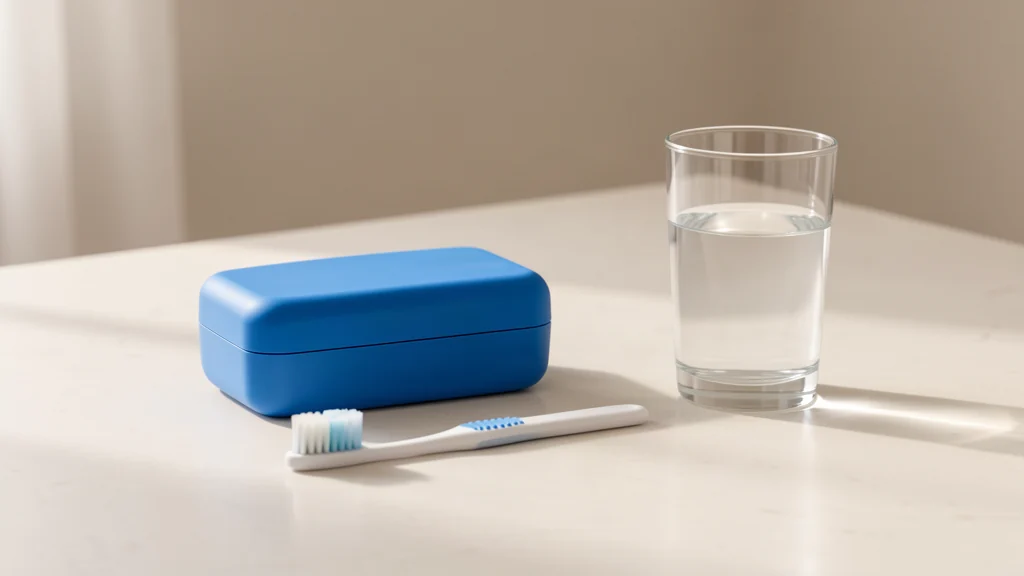
Keep follow-up visits even when the partial feels fine. Teeth can decay, gums can change, clasps can loosen, and the ridge under a missing tooth can change shape. An adjustment is different from a repair or a new appliance. I need to see the fit and the mouth before deciding what is appropriate.
Frequently asked questions
Do all of my remaining teeth have to be removed for dentures?
No. A partial denture is specifically designed for someone who still has natural teeth. Removal is considered only for teeth that cannot be kept predictably or that would interfere with a sound treatment plan.
Can another tooth be added to my partial later?
Sometimes. It depends on the partial’s material, design, condition, and the location of the newly missing tooth. Some appliances can be modified, while others need to be remade. Bring the partial to the visit so I can evaluate it.
Will a partial denture damage my natural teeth?
A well-planned partial should distribute forces carefully, but the supporting teeth still need good cleaning and regular checks. Plaque, decay, gum disease, a loose clasp, or a poor fit can create problems if they are ignored.
Can implants help support a partial denture?
They can in selected cases. Implants may improve support or stability when the bone, health history, and treatment goals allow it. An examination and imaging are needed before I can say whether that approach makes sense for you.
Missing several teeth in Peculiar?
I can examine the teeth you still have and compare realistic replacement options without assuming the answer in advance. Read about my background and approach, or schedule with Peculiar Family Dental online.